
On Small Potatoes
Beginning to reckon with tiny tubers

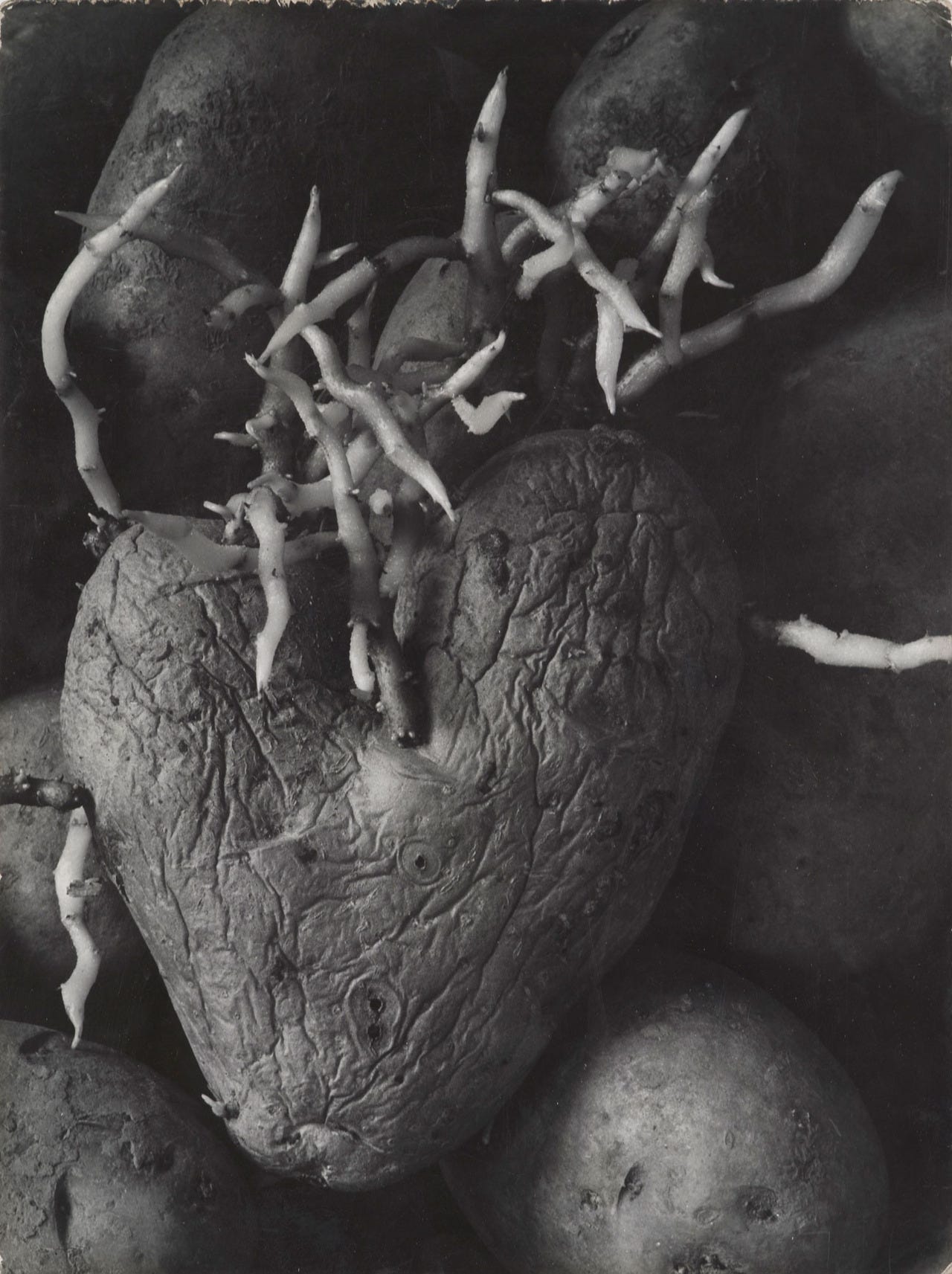
Hello, and welcome to Petite Patates, a place to read about, think about, and reimagine the everyday (for now, at least). I’m calling this newsletter Petite Patates because “Small Potatoes” was already taken (so sad), but also as an homage to one of the patron saints of potatoes, and of small potatoes in particular — filmmaker Agnes Varda. Varda loved potatoes — a passion I explore in an episode of Radiolab that will be released on April 19.
Inspired by Varda, and many others, I’m excited to offer a bit of a Small Potatoes Manifesto for my first post. Or, if not a manifesto, at least an invitation to join me on a journey to figure out how to engage creatively, intellectually, and emotionally with all the ordinary, potatoey parts of life.
Yesterday, I bought a bag of small potatoes. They are different colors — purple, yellow, brown — and a variety of small — tiny, medium, fingerlike. They are lumpy, with deep and shallow crevices, and also smooth, with broad surfaces that I can run my thumb over like a lucky stone. They are mottled and pocked and occasionally shockingly unsullied, an expanse of pigment without blemish. One or two are very hard, but most of them have a softness that suggests age. They smell like nothing. They are cold.
These potatoes are potatoes—I plan to roast them later with oil and salt—but they are also something else. They are a symbol, a living metaphor, an embodiment of an idea. They are small potatoes, yes, but they are also small potatoes, a phrase that we use to mean ordinary, common, “no big deal.” The phrase derives from the 18th century, when potatoes were becoming a staple of the diets of peasant peoples in Europe, helping to end mass starvation in Ireland, Prussia, and Germany. For those who relied on potatoes, the small potatoes were less desirable than hearty spuds, and literally less valuable. A small potato was something trivial, something insignificant, particularly in comparison to a larger thing, such as, for example, a large potato.
When we say things are “small potatoes,” we are talking about parts of our lives that are, seemingly, no big deal. A walk to the grocery store to buy an ingredient for dinner. Scrubbing a plate. Anxiety about making a left-hand turn. Ordinary moments that easily slip through our fingers and out of our memory, even if they may feel full of emotion in the moment. Often they are annoyances, or things that feel privately or momentarily meaningful but are objectively or ultimately negligible. They are banal and easy to dismiss. Small potatoes are the kinds of things that we rarely spend time analyzing or investigating, because why would we? What is there to say about the feeling in your head just before you get a cold? Or the feeling of satisfaction when you fold a whole load of laundry? Who really cares?
They are also, definitionally, small, which suggests a point of comparison. If there are small potatoes, they must be small in relation to something else, something bigger, something more meaningful. When we say something is “small potatoes,” we mean that it’s no big deal compared to something that is, in fact, important -- global injustice, personal tragedy, ecstatic joy. These registers of human experience are Big Potatoes. They are undoubtedly worthy of our time and consideration.
And yet, our lives are made up of these small, everyday moments. Ordinariness, after all, is a phenomenon that is nearly all-encompassing. It is almost everywhere. Most of our lives unfold on ordinary days, doing ordinary things. We wake up, clean the house, care for our children, go to work, decide what to eat, brush our teeth, take the bus, watch television, and tuck ourselves into bed. What constitutes ordinariness, exactly, is different for all of us, and it is fundamentally tied to questions of identity, geography, money, and safety. But ordinariness is the rule. That’s more or less what it means -- an ordinary day is a typical day, a day when nothing special happens. Like most days.
And even on an extraordinary day -- a wedding day, a death day, a life-changing day -- there are countless moments of everydayness, of triviality, of routine. You comb your hair and tie your shoes. You pour the grounds into the coffee filter. You enjoy the peculiar delight of popping a pimple. Most of life is small potatoes. Annie Dillard said it this way: “How we spend our days is how we spend our lives.”
But it is also true that, despite the sheer volume of ordinariness in our lives, we are always fleeing the ordinary (or trying to), disregarding our most mundane moments, moving past them in the pursuit of something larger and more significant. I know I am. Inside every ordinary day, I imagine myself into an extraordinary one. I build fantasy houses in my daydreams, modernist upstate getaways with huge windows to gaze at snowy landscapes; apartments in Rome with warm light and giant bathtubs; seaside cottages with extra rooms for every friend I’ve ever known. I spend my commute vividly conjuring a life where I am famous and rich, smarter and more interesting, more beautiful and more loved. These fantasies— themselves ordinary— are, at least in part, about escaping ordinariness. They are a way for us to imagine ourselves as a person who has transcended beyond the mundane. Rarely do we daydream about an extraordinary life that includes washing chocolate fingerprints off the sofa or waiting on an extended hold with the health insurance company.
It’s an understandable gesture, this fleeing, because the temptation, the habit, is to always perceive the ordinary as boring. After all, we’ve all had a cold, or been put on hold by the bank, or stood with our hands plunged into a sink full of dishes. The very commonness of these experiences, and their repetition, make them feel like there is nothing possibly interesting about them, nothing that could delight or instruct or enlighten. The ubiquity of the ordinary means we feel that we’ve seen it all, know it all, cannot be surprised.
For months now, years even, I’ve been thinking about small potatoes, which is another way of saying this: I’ve been trying to understand what to do in the face of the sheer ordinariness and repetition of my life, and maybe even life in general. Nearly two years ago, I gave birth to my daughter, and I encountered a new and wonderful yet deeply ordinary thing: I wanted every moment with my daughter to last forever, even as I couldn’t wait for many of them to end. I felt delighted, bored, grateful, and annoyed. Although I had felt all of these feelings many times before, something about being a mother made me yearn to understand them more deeply.
For the past handful of months I’ve been asking questions: How do artists and philosophers understand ordinariness? How do political thinkers and climate change scientists and novelists grapple with the everyday? Is the mundane beautiful, or politically charged, or is it mostly just something we have to tolerate? And what might all of this teach me about my own day to day life?
I’m trying to find out. I see this newsletter as a chronicle of my search to understand the everyday, even as it is also an appreciation of everyday things. Anticipate posts on fudge and sand and looking at the moon as well interviews with artists and other people about ordinariness. Also anticipate some more posts about potatoes (they are fascinating! and strange!), and probably some posts about non-ordinary things.
In any case, thanks for reading. Grab a bag of tater tots, and enjoy!
P.S. The image at the top is a photograph taken by Agnes Varda in 1953 called Pomme de terre coeur, or Heart Potato.
Just heard the last 4 minutes of the broadcast on WBUR. I have never been more confused. I do however love potatoes. Count me in. Any chance the full audio will be released online?
Mundanity is necessary! t allows the extraordinary moments to be extraordinary. It is like a palate cleanser. I think we subconsciously acknowledge this importance and allow mundanity to linger when it needs to.